
Rennylea Research
Rennylea has always collaborated with research organisations to contribute to industry knowledge.
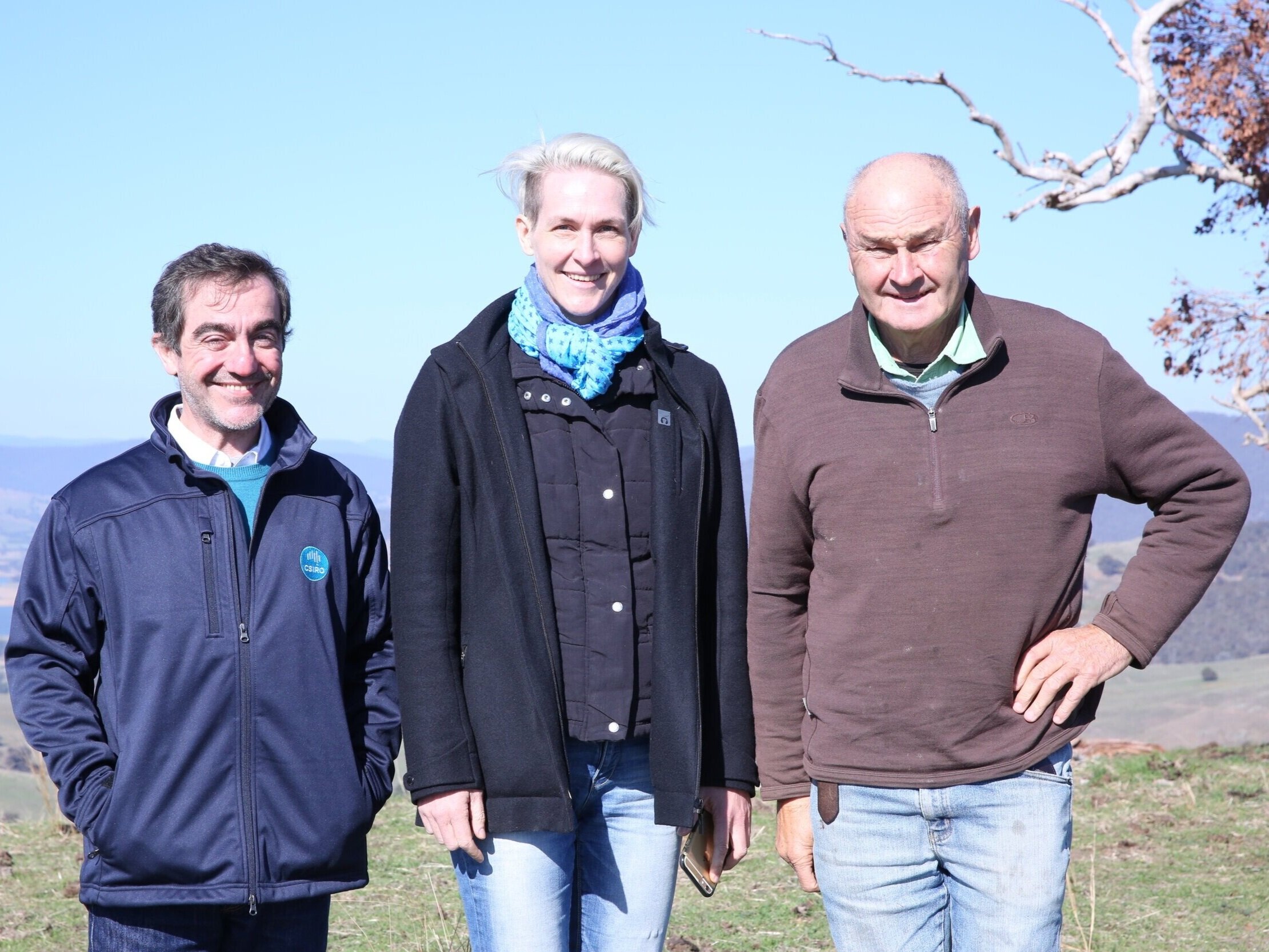
Drs. Toni Reverter and Sonja Dominik at Rennylea with Bryan during their visit to discuss the Innovations Connection project on genotyping the Rennylea herd.
Historic Research
Over 20 years we participated in 3 Beef CRCs from 1992 to 2012, the Trans Tasman Maternal Productivity Project from 2013 - 2017 and more recently short term projects to answer specific questions, with other research institutes.
After the adoption of genomics in 2015 we carried out a research project with the CSIRO through their Innovations Connection programme to investigate the effect of adopting genomics in the herd. We collaborated with a geneticist and data scientist to analyse the benefits of introducing wide scale genomic testing into the Rennylea herd. This gave us the confidence to implement genomic testing across the herd including all bull and heifer calves.
We followed up with a project with the University of Adelaide with Prof. Wayne Pitchford and Dr. Stephen Lees looking to incorporate MSA indicies from commercial clients into our Breedplan data base and decision making. Given there are 3.2 million carcases are graded each year through Meat Standards Australia, the large amount of data harvested is a massive opportunity for genetic selection.

Recent Research
In 2019 a Dung Beetle Ecosystems Engineers project was established at Rennylea, funded by Meat and Livestock Australia. The project is managed by a team at Charles Sturt University led by Professor Lesley Watson and Dr. Russell Barrow. Preliminary findings are very encouraging with the range of active dung beetle species having increased from 4 to 13 throughout the years since 2003.
The aim of the project was to study the activity of dung beetles through the year, release and study some new varieties from Morocco and France and see if various farming practices help or hinder the establishment of the beetles.
We learned ways to spread the dung beetles through cow pats across the farms, monitor the frequency during the year and in time, introduce new species to fill the gaps in dung beetle activity.
Current Research
Current projects revolve around the efficiency of production. The first of these is to develop research breeding values for cow body composition and their relationship to other traits of interest. In the current Breedplan traits there is a lack of a description of how females maintain body condition as energy resources and are partitioned to lactation, growth, reconception and maintenance.
The working title for this work is Mating 2 Predicted Cow Body Composition, PM2BCS. The range in values from 2,000 observations is a full condition score. The results for Rennylea heifers covered the entire range of the population studied with a clear difference being a tendency for genetically higher PM2BCS than the evaluated population.
In 2026 we are commencing data collection for the Bluegrass project, designed to capture methane emissions in the paddock with the use of Optiweigh and AgScent units fitted within them.
As this project progresses we shall update the reports on this page.